


Nature - 2018 November - Vol 563 No 7733
Publisher: Nature
Format: Paperback
ISBN: 9770028083095
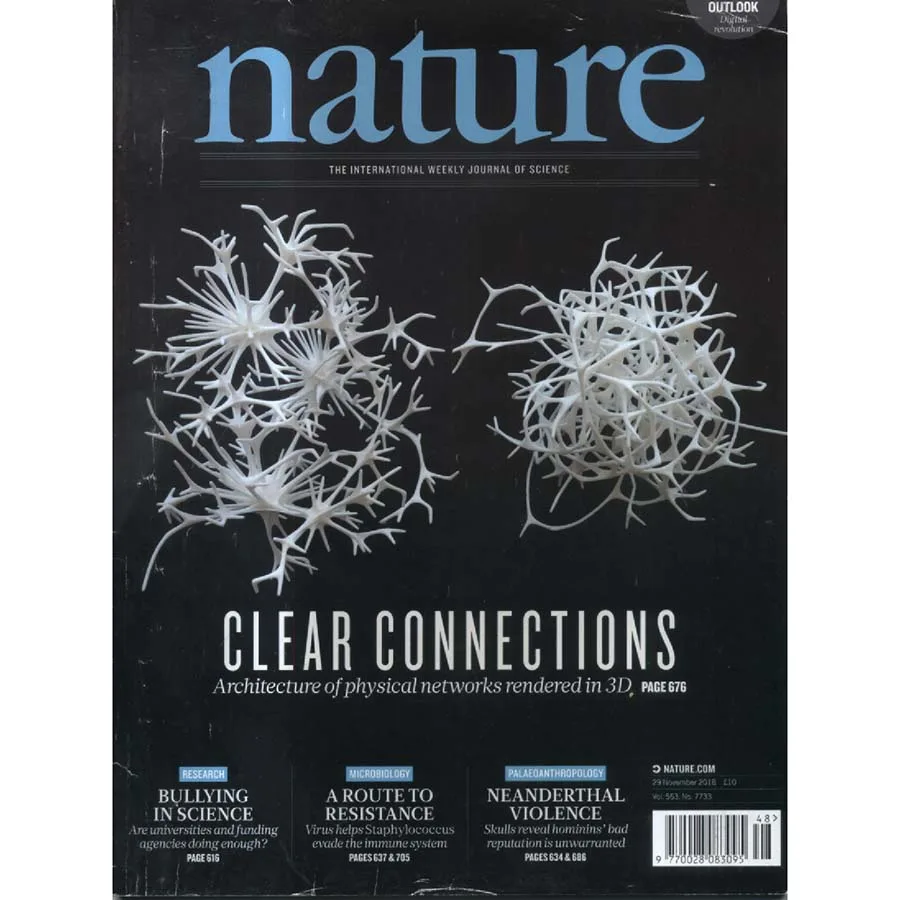
There are magazines that merely report on the world, and then there is Nature, quietly documenting the structure of reality itself while simultaneously making ordinary readers feel as though they may need another three university degrees just to interpret the cover properly. Nature – November 2018, Vol. 563 No. 7733 is a particularly beautiful example of this phenomenon.
The headline:
CLEAR CONNECTIONS
accompanies two ghostly white neural-like structures floating against a black background like biological sculptures recovered from an alien civilisation. The official explanation — “Architecture of physical networks rendered in 3D” — somehow manages to sound both scientifically precise and vaguely existential at the same time.
Modern science publishing has become astonishingly artistic. At this point, many issues of Nature look less like journals and more like conceptual gallery catalogues for extremely intelligent people who own microscopes worth more than cars.
And the irony is that the underlying science is even more extraordinary than the artwork.
Inside, researchers explore:
-
three-dimensional network structures,
-
microbial resistance mechanisms,
-
Neanderthal violence,
-
and bullying within scientific institutions,
which together provide a wonderfully comprehensive portrait of humanity:
-
mapping hidden systems,
-
fighting bacteria,
-
reassessing ancient brutality,
-
and discovering that even elite research environments remain populated by human beings behaving like human beings.
One of the great joys of Nature is this constant collision between breathtaking intellectual progress and timeless social dysfunction. We can render physical networks in astonishing 3D detail, yet still apparently struggle to stop academics behaving badly in departmental meetings.
Civilisation is complicated.
Reading 2018 issues of Nature now also produces a strange historical sensation. This was the final period before the 2020s transformed public conversations around science, expertise and global systems. The tone here remains almost serenely confident: careful peer review, rigorous evidence and the steady accumulation of knowledge proceeding in calm institutional order.
Then, of course, history accelerated dramatically shortly afterwards.
The issue’s themes feel surprisingly modern nonetheless. Network architecture, immune resistance and scientific culture remain absolutely central concerns today. In hindsight, one realises how much of contemporary life increasingly revolves around invisible systems:
-
neural networks,
-
biological networks,
-
social networks,
-
information networks,
-
and institutional networks quietly determining reality beneath the surface.
Which makes the cover unintentionally profound. Humanity in the late 2010s was becoming increasingly aware that everything connects to everything else in ways both beautiful and alarming.
The visual design deserves enormous admiration too. Scientific imaging now routinely generates forms so aesthetically sophisticated they resemble abstract sculpture. Those branching white structures on the cover could easily sit inside a contemporary art museum accompanied by a plaque discussing “fragmented modern consciousness.” Instead, they are actual scientific renderings, which somehow makes them even better.
Physically, this issue radiates the unmistakable aura of advanced intellectual seriousness. One imagines it originally sitting in:
-
university laboratories,
-
medical research institutes,
-
neuroscience departments,
-
or on the desks of researchers calmly discussing multidimensional systems while surviving primarily on caffeine.
Yet now it survives as both scientific document and cultural artefact from a fascinating transitional moment — a world increasingly interconnected technologically and biologically, but not yet fully aware how turbulent the coming decade would become.
Condition-wise, this copy is listed as Good, meaning it has survived admirably despite likely exposure to laboratories, crowded academic offices and perhaps at least one owner who opened the microbiology article casually before discovering bacteria possess strategic capabilities disturbingly close to military planning.
Today, Nature – November 2018, Vol. 563 No. 7733 stands as a remarkable snapshot of modern scientific culture: intellectually ambitious, visually stunning and quietly obsessed with uncovering the hidden structures underlying existence itself.
An excellent acquisition for science enthusiasts, collectors of academic ephemera, lovers of striking modern design or anyone who enjoys magazines capable of making them feel simultaneously enlightened and deeply suspicious that reality is far more complicated than previously assumed.
Keep browsing: See more Nature Journal books Other books by Nature
